I have friends on Facebook who seen to be constantly angry, based on their posts. They are angry about politics, about immigration enforcement, even about things as silly as personal pronouns. If a certain elected official would post, “It’s a nice day today,” they would be angry about that. I suspect that what they’re really angry about is their own lives. Things are not going as well as they’d like. Maybe they’re going in a really crappy direction.
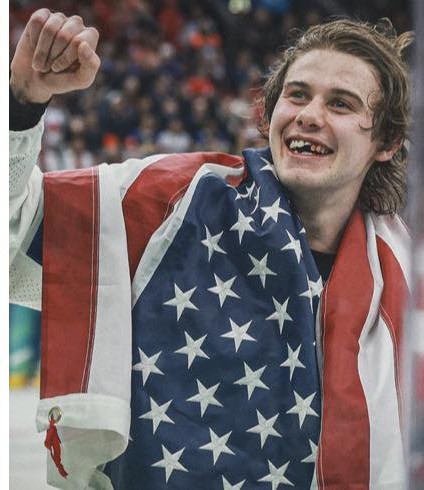
And then we have Jack Hughes. He’s the guy in the picture.
I don’t know Jack Hughes. He’s a professional hockey player. Born in Florida, he spent most of his childhood in Toronto, where his father worked for the city’s NHL team, the Maple Leafs. Jack and his family relocated to Michigan for his high school years. He is a practicing Jew. His parents were both star athletes in college.
At 18, Jack was drafted by the New Jersey Devils of the NHL. He was good enough to make the team coming out of training camp and scored his first NHL goal against Vancouver. His older brother, Quinn, was on that team.
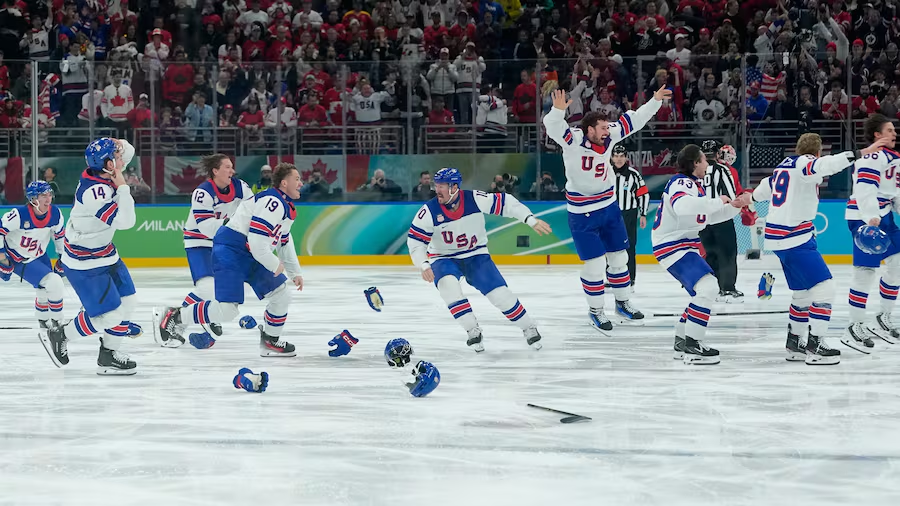
The brothers were members of the US team that captured the gold medal at the Milan Olympics. In the third period of yesterday’s championship game against Canada, Jack took a stick to the face that broke three teeth. He got treatment on the bench and stayed in the game. In overtime, he scored the game-winner on a tremendous display of hockey skill, out-dueling a Canadian defender in an epic one-on-one battle and shooting the puck past one of the world’s best goaltenders.
After the game, Jack told the TV audience, “I’m so proud to be an American today.”
Jack Hughes and his teammates came from varying backgrounds and joined together to do one thing: to bring a gold medal back to their country. The same USA that had provided them and their families with opportunities for growth and success. But nobody was going to hand them the gold medal. They had to earn it. Their country didn’t just hand things out to them and their families. They had to earn their way to the top. These men worked hard for years to be great hockey players. Then they came to Italy and had to win six consecutive games against the best players in the world. Two of the games went to overtime. They persevered, sacrificed together, worked together, and they won together.
Jack and Quinn Hughes and their teammates gave us two weeks of sensational hockey. Fans are calling the gold-medal game the greatest hockey game ever played. It’s certainly the best I’ve ever seen, and I’ve been calling hockey games on the radio for the better part of the past 35 years.
But you know what the best part of all this was? Jack Hughes didn’t just play a great hockey game yesterday. He and his teammates showed us all back home what can be accomplished when people put aside their differences and work together toward a goal: to be the best they can be. These men wanted to be the best hockey team on the planet. The rest of us back home want to be the best country on the planet.
They showed us how it can be done. Teamwork. Sacrifice. Maximum effort. There certainly were petty squabbles that emerged within the team from time to time, rivalries and perhaps even grudges from their time as NHL opponents. The coaches displayed strong leadership in pulling everyone together, keeping everyone focused on the goal: to win.
We can do that as a nation. We can be the best in the world. We have everything we need to get there: the resources, the tradition, the talent. It’s all here. It’s been here for a long time, but recently it seems that we’ve lost the ability to make it happen. We see a problem and instead of figuring out how to fix it, make things better, we point the finger at someone else for causing it, without suggesting how it can be fixed. Just get rid of the other guy and it’ll be fine, we seem to think.
But that’s not how things work. Not on a hockey team, not in a country. It takes all of us, pulling together, helping each other, seizing the moment, getting action. In six hockey games, this group of young men showed us how that can be done.
The question now is, were we really paying attention?
 A Strenuous Writer's Life