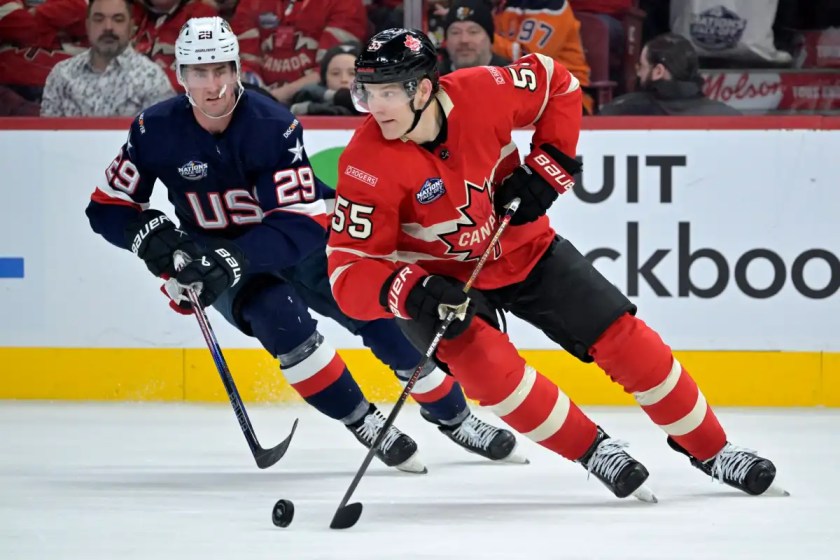
It’s a Sunday afternoon in the middle of February, and I’m about to watch a hockey game. Not just any hockey game, but an Olympic game, Team USA vs. Germany in the first round of the men’s tournament. The Winter Games have been underway for more than a week now over in northern Italy, but this will be only the second–no, make that third–event I will have watched, even for a few minutes. The first was a week ago, when I happened to catch an Italian figure skater doing his solo routine that clinched the team bronze medal for his country. It was a beautiful program, and anybody watching had to admire the man’s grace and athleticism on the ice, not to mention the discipline that had gone into the untold hours of training that got him to that ultimate moment. The other event I caught, a few days later, was a hockey game, the last few minutes of our guys’ 6-3 win over Denmark.
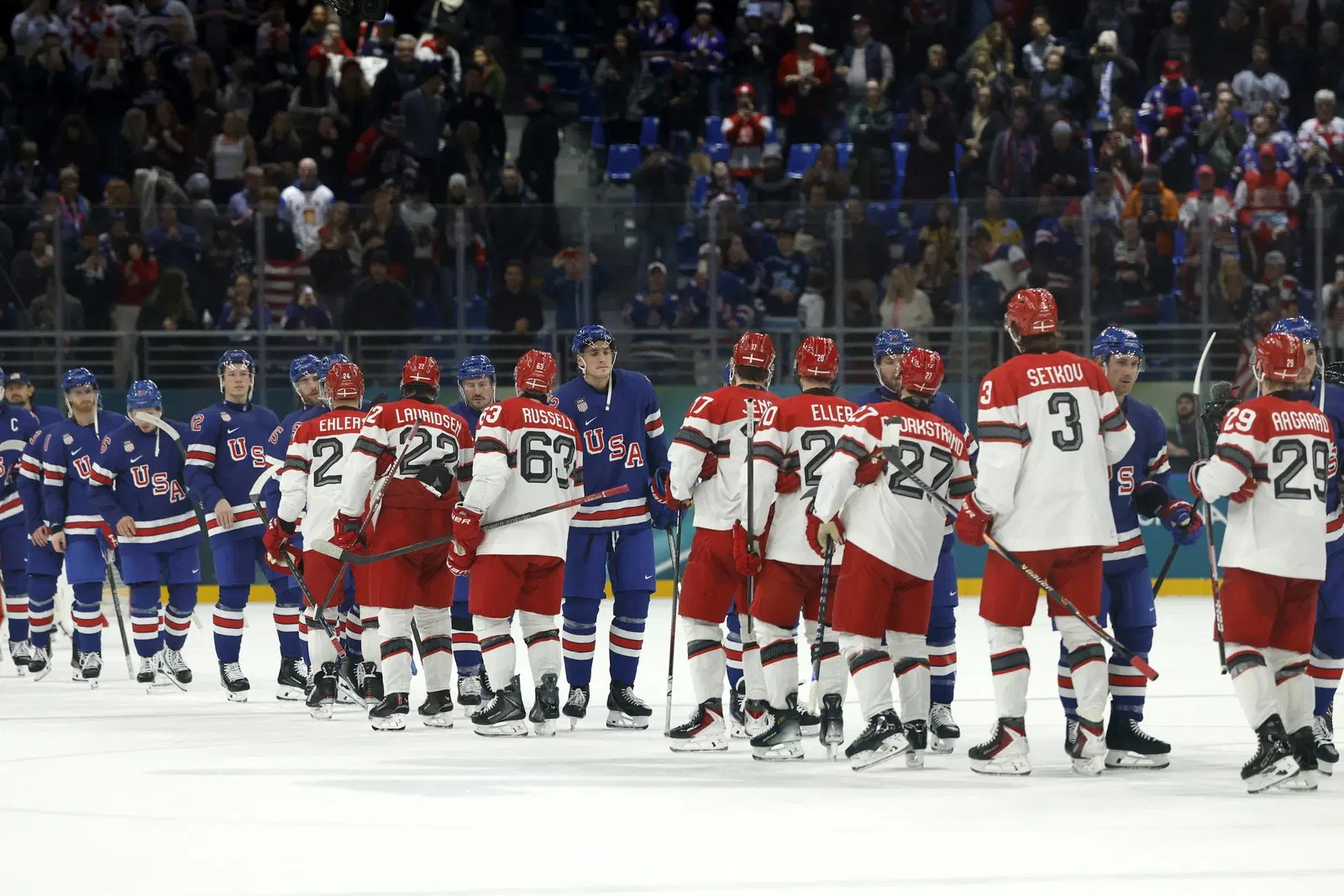
Today’s game against Germany is the third and final game in the preliminary round for both teams. With a win, the US squad finishes a perfect 3-0 and would clinch a spot in the quarterfinals. There are 12 teams competing in the Milan Games, divided into three groups. At the end of round-robin play, the group winners move on to the quarterfinals, along with the 2nd-place team with the best record. The remaining eight teams then move into a single-elimination round to produce the last four teams in the quarterfinals. Canada has already qualified for the quarterfinals by blasting France earlier today, 10-2, to finish group play at 3-0. It’s expected that it’ll be Team USA vs Team Canada in the gold medal game.
The illustrious history of Olympic hockey.
Canada has won 9 gold medals in Olympic competition, most recently the 2002, ’10 and ’14 Games. The 2014 event was held in Vancouver, British Columbia, only the second Winter Olympics ever held in Canada, so the pressure on the home team to win gold was intense. In the previous Canadian-based Games, held in Calgary in 1988, the Canadian team didn’t even win a medal. Our neighbors to the north won six of the first seven Olympic hockey competitions, dating back to the first, in 1920 at Antwerp, Belgium. But after the last gold medal of that early run, won in 1952 in Oslo, Norway, the Russians took charge. From 1956 through 1992, Russian teams won eight of ten competitions, the first seven as the Soviet Union and the last as the “Unified Team,” following the breakup of the USSR.
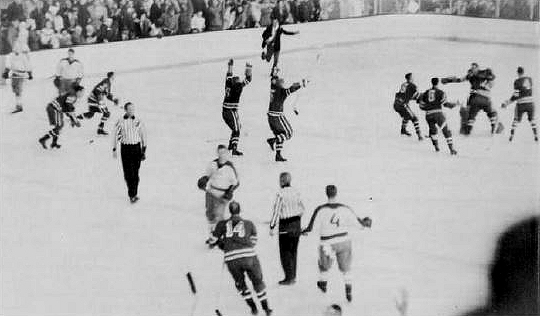
We haven’t done nearly as well as the Canadians and Russians, historically. Both of our gold medals came in games conducted in New York state: 1960 in Squaw Valley and 1980 in Lake Placid. The 1960 team won its 3-team group with a 2-0 record and then went unbeaten through the six-team medal-round group, beating the Canadians (2-1) and Soviets (3-2) along the way. Australia had a team in the field that year; they went 0-5 overall and were outscored 87-9. The Aussies haven’t been back on Olympic ice since then.
Our 1980 team, of course, captured the gold medal in the thrilling “Miracle on Ice” game against the Soviet Union. We had a team of college players going up against virtual professionals; the rules of the day prohibited National Hockey League players, not to mention those from European professional leagues, from playing. The Russians got around this by saying that their players weren’t pros; they were soldiers or factory workers who just happened to play hockey. I remember one of the players saying that his entire employment for the Spartak tractor factory was playing hockey nine months of the year and teaching hockey the other three months.
The coach of Team USA was Herb Brooks, then 42, the coach at the University of Minnesota. He’d just won the 1979 NCAA championship, his third at the helm of the Gophers, and the players he chose formed the youngest team in the Olympics, averaging only 21 years of age. A native of St. Paul, Minn., Brooks was known as a master motivator. He was the last player cut from the 1960 team and played on the ’64 and ’68 Olympic teams.
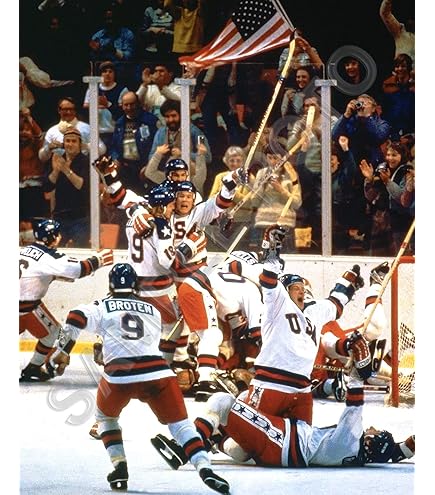
Mark Johnson, currently the head coach of the University of Wisconsin women’s team, was a key player on the 1980 team, scoring two goals in the game. His first, with one second to go in the first period, tied the score at 2-2. It also prompted Soviet coach Viktor Tikhonov to pull his goaltender, Vladislav Tretiak, who was widely acknowledged as the best goaltender in the world, for backup Vladimir Myshkin, a move Tikhonov would later acknowledge was the worst mistake of his life. Myshkin kept the Americans off the board in the second period while the Soviets scored on a power play to take a 3-2 lead into the final 20 minutes. Johnson scored again at 8:39 as a US power play was ending, tying the game. Mike Eruzione, who had just come onto the ice for his shift, fired one past Myshkin 1:11 later. The Americans held on for the final ten minutes and then celebrated the win in what many fans still consider the greatest hockey game ever played. The final minute, with a young Al Michaels making his famous game-ending call, is a classic: Miracle on Ice.
There have been two movies made about that 1980 US team. The first, a TV-movie produced rather quickly shortly after the Olympics, featured Karl Malden as Coach Herb Brooks. A much better version was released in theaters in 2004, starring Kurt Russell as Brooks. The coach’s pre-game speech to the team before taking the ice against the Soviets was masterfully recreated by Russell: Miracle pre-game speech.
The United States has not won gold since. The International Olympic Committee allowed NHL players to compete in the Games starting in 1998. For those Games in Nagano, Japan, and the next four, the best players in the world went after it, providing hockey fans with some dream match-ups. Despite having most of the NHL players taking the ice, Canada and the US didn’t dominate. Neither team even medaled at Nagano. In 2002 at Salt Lake City, the home team lost the final to Canada. Again, both teams fell short of the medal round in 2006, in Italy. Four years later in Vancouver, Canada and the US played a spine-tingling gold medal game, with the home team winning in overtime, 3-2. The 2014 Games in Sochi, Russia, saw the US fall to Canada, 1-0, in the semifinals; the Canadians beat Sweden for gold, while the Americans’ collapse continued in the bronze-medal game, losing to Finland, 5-0. After outscoring its opponents 20-6 entering the medal round, Team USA was blanked 6-0 in its final two games.
NHL players didn’t compete in the 2018 and ’22 games, thanks to a dispute between the governing bodies involved. Russia used players from its own domestic pro league and was favored in ’18 in South Korea, but a doping scandal caused the International Olympic Committee to ban the Russian team. Individual athletes and teams were allowed to compete under the Olympic flag after passing anti-doping tests, and the “Olympic Athletes from Russia” won the gold over Germany, with Canada taking bronze. The ’22 Games in China saw NHL athletes staying home, ostensibly due to concerns about COVID-19; Finland had no issues with that and won gold, beating another unofficial Russian team in the final with Slovakia taking bronze.
The gals finally get to play.
Women were allowed to compete in hockey beginning with the Nagano Games in 1998. Without a North American professional league until recently, both Canada and the US had to rely on college players and older women who’d played in Europe, although North American pro leagues for women quickly started up, thanks to the exposure the game received in the Olympics. American and Canadian teams had been facing off against each other for years in international tournaments, almost evenly matched. The US beat Canada 3-1 in the first Olympic women’s gold medal game. Canada took the rematch in Salt Lake City four years later. Sweden upset the Americans in a shootout in the ’06 semifinals, but the Swedes had little left in the tank after that, losing to Canada 4-1 in the final. The Canadians won their third consecutive gold medal in 2010 with a 2-0 shutout of the US.
There was talk back then of removing women’s hockey from the Olympics, with critics (virtually all from Europe) complaining that the tournament had been dominated by Canada and the US, who had combined to win seven of eight gold and silver medals in the four Olympic tournaments that had been contested through 2010. Hayley Wickenheiser, one of the best Canadian players, argued that the reason North American teams were ahead of the Europeans was the presence of professional women’s leagues over here and the support for women showed by the US and Canadian Olympic Committees. The Europeans decided that stepping up their game would be better than taking their pucks and going home.
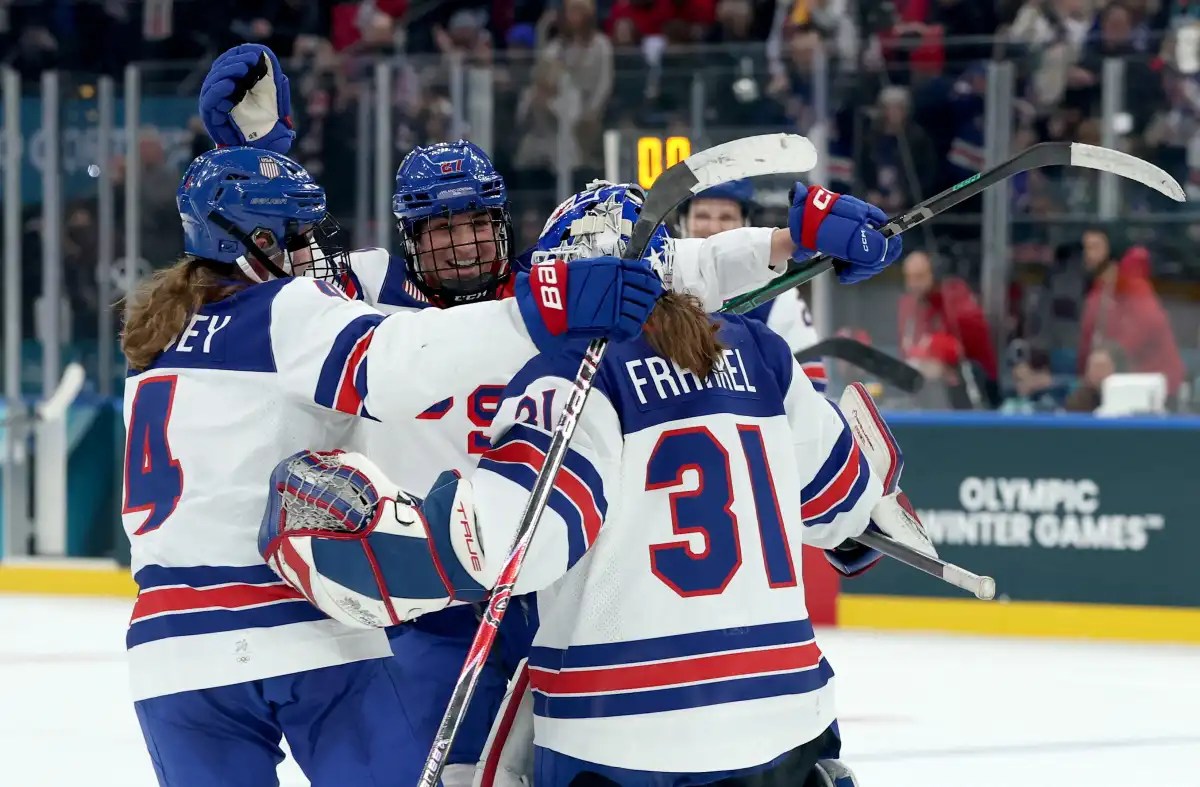
The North American rivals met for the next three gold medals, with Canada winning twice. This year, the American team is the favorite, loaded with Olympic and international veterans and some of the best active college players, including four members of Mark Johnson’s Wisconsin Badgers, who won the NCAA Division I title last season. Team USA has blown past everybody so far, outscoring its five opponents 26-1 on the way to a semifinal showdown with Sweden tomorrow morning. Canada plays Switzerland, with the winners facing off for the gold medal on Wednesday.
My first hockey game.
I never played hockey as a youngster; growing up in southwest Wisconsin, I wasn’t in hockey country, like kids up here in the northwest. Occasionally I’d watch the Badger men’s team on TV. Led by Coach Bob Johnson, Mark Johnson’s father, Wisconsin won three national championships in his 15 years at the helm. When my broadcast career took me to Menomonie, in west-central Wisconsin, in 1990, I was asked if I could do hockey on the radio. Sure, I said. I’d never seen a game in person at any level, but I’d seen many on TV, and so I studied the rules, thinking, “How hard can it be, anyway?”
Well, it was pretty hard. My first broadcast, Menomonie High School hosting Chippewa Falls, was a disaster. Let’s just say I’m glad no tape exists. But I learned quickly, was frequently helped out by our Minnesota-born news director, Terry Miller, and the team went on a roll as the playoffs arrived. The Indians qualified for the state tournament in Madison, which in those days had an open format, with no divisions based on enrollment. Less than three months after calling that first game, there I was, in the booth at the Dane County Coliseum, where the Badgers played. Menomonie won its quarterfinal game over Monona Grove, then upset Madison Memorial in the semifinal, 2-1, setting up a championship showdown with mighty Superior.
In those days in Wisconsin, playing Superior in hockey was like playing the Soviets. All-time, the Spartans have qualified for 39 of the 55 tournaments played since the first in 1971. By the time they took the ice against Menononie in the ’91 title game, they’d won six state titles in the event’s first 20 seasons, including the year before. But the Indians hung in there and got the victory, and the championship, in a pulse-pounding 3-2 victory.
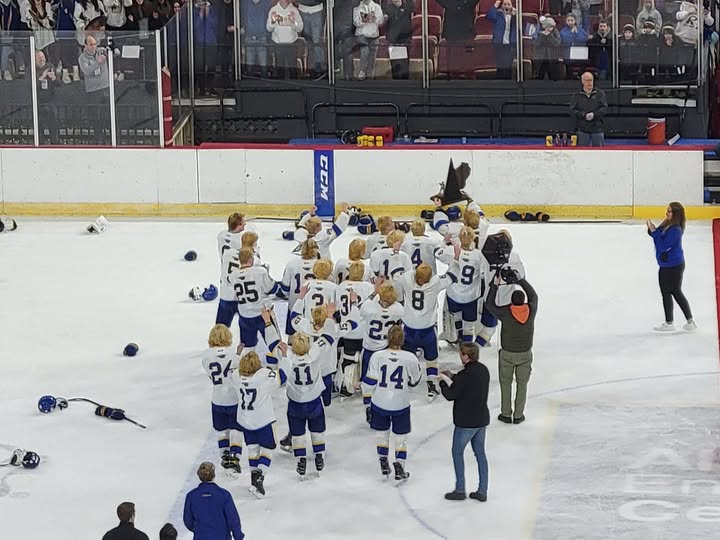
I made it back to Madison for the hockey finals three more times in my career. In 2013, I followed the Hayward girls team to the title while working for WRLS/Hayward. Seven years later, back on WJMC/Rice Lake, the Rice Lake Warriors made it to the first-ever boys Division 2 semifinals, losing to a private school from Fond du Lac. In 2022, the Warriors made it again, this time turning the tables on St. Mary’s Springs with a win in the final game for the championship.
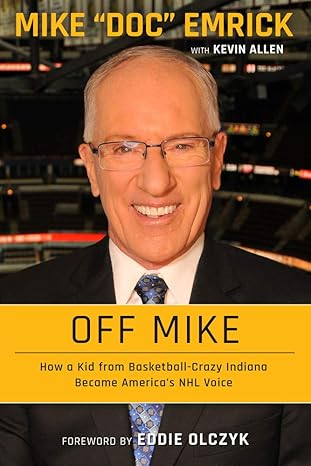
I enjoy broadcasting hockey. It’s not easy, especially if you have no background in the game as a player, but it can be very exciting. For occasional NHL games on TV, not to mention the Olympics, I’d enjoy listening to Mike “Doc” Emrick, who was the preeminent hockey play-by-play announcer for many years until his retirement in 2020 after nearly half a century at the mic. I learned a lot from him; although I’ve never met Doc, I enjoyed his book:
This season is likely my last calling hockey. Unfortunately, the Warriors are suffering through a very down year, and another announcer will be handling their first-round playoff game from Siren this coming Thursday night. If Rice Lake can pull the upset, I’ll pick them up for the sectional semifinal on the 24th. Maybe they can put together a miracle run and make it back to the Madison area (the tournament is now held at a newer, smaller arena in nearby Middleton). If so, it’ll be another Miracle on Ice.
UPDATE: The US men beat Germany, 5-1, moving on to the quarterfinal round later this week. The women’s team plays Sweden in the semifinals tomorrow, with Canada against Switzerland. The winners play for gold on Wednesday. I’ll have to set my TV to record that one, as I’ll be on the road to Milwaukee for a quick visit with son Jim and his gal Jessica. By the time I get home the next day, I’ll already know the result, but it’ll be fun to watch anyway…unless the Canadians win, of course. Nothing personal to our friends up north.
 A Strenuous Writer's Life