
It’s not often that you really root for someone these days. Not counting family, of course. We can sit in the stands (or, more often, in front of our TV sets) and cheer on our favorite sports team, and there might be one particular player we’ve followed for a long time. But a fictional character, well, that’s a different story. Literally.
Last week, Netflix dropped the final five episodes of Cobra Kai, concluding the sixth and final season of the series that was based on The Karate Kid movies of the 1980s. The producers could have taken the themes of those early films and translated them to a modern setting, re-inventing the characters entirely, but they didn’t. Instead, they chose to bring as many of the central characters back as possible, played by the original actors, now some 40 years older. Could this possibly work?
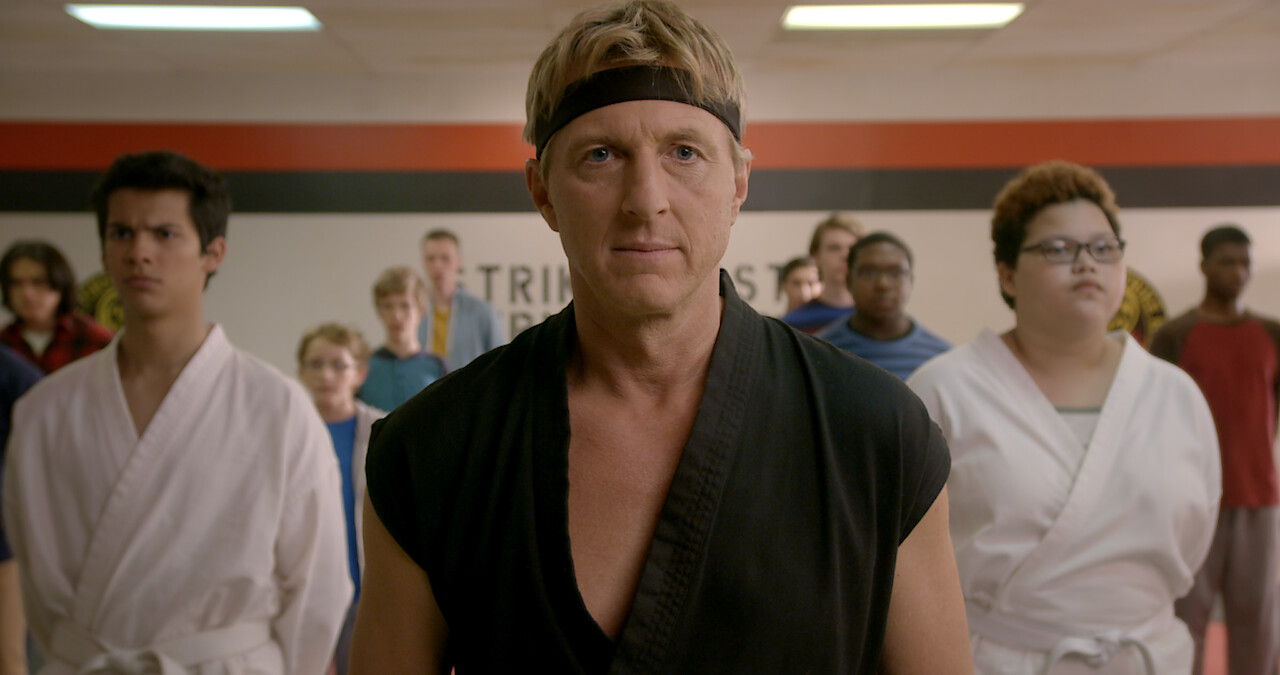
It sure did. After debuting on YouTube’s short-lived Red service in 2018, the series came over to Netflix for season 3 in 2021 and has consistently racked up huge viewership numbers. Critics have given the series high marks and fans are nearly unanimous in their praise, with an aggregate rating of 94% on Rotten Tomatoes. There’s talk that William Zabka will be nominated for an Emmy for his performance as Johnny Lawrence in season 6. Zabka certainly deserves it, I’d say. His portrayal of Johnny as a man haunted by a teenage defeat and finally getting redemption after nearly four decades is the highlight of the series.
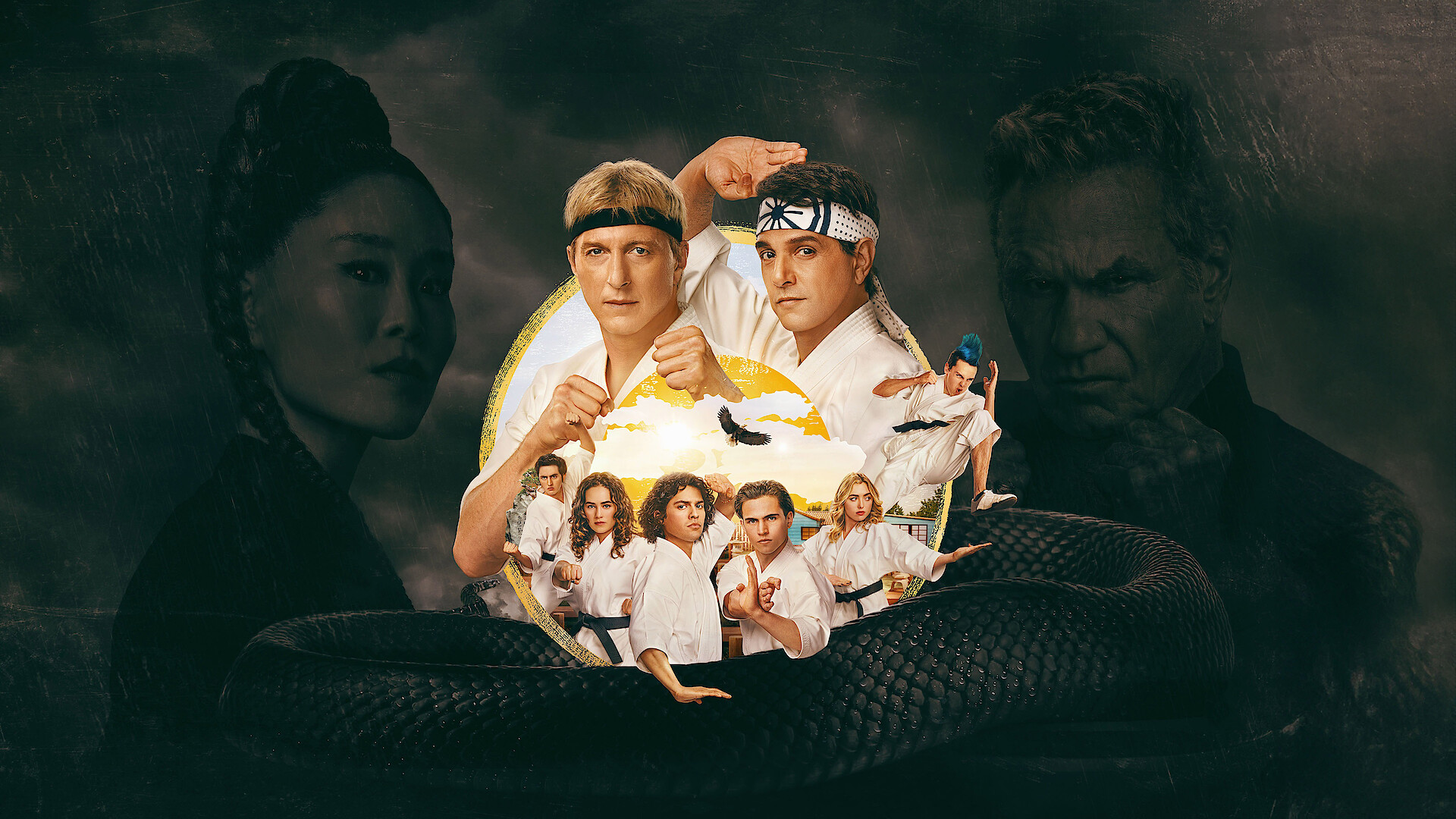
Go, Johnny, go!
When we first meet Johnny Lawrence in the 1984 film, he’s the top karate fighter in the San Fernando Valley. Two-time All-Valley titlist, he’s The Man at his high school and the top student at the Cobra Kai dojo, led by a tough-minded, ethically-questionable Vietnam veteran, John Kreese (Martin Kove). Then, in one moment on the mat, it all comes crashing down for Johnny. He’s beaten in the title bout by a newcomer, a skinny kid from New Jersey named Daniel LaRusso (Ralph Macchio), who has been trained by a humble Japanese gardener, Mr. Miyagi (Noriyugi “Pat” Morita).
It’s Johnny’s own fault, of course. He had LaRusso on the ropes (figuratively speaking; martial arts competitions don’t use roped rings, like boxing) in the title match. With the score tied at 2-2 and the next point deciding the championship, Lawrence couldn’t dispatch Daniel even though the less experienced fighter was hobbled by an injured leg (the result of a disqualifying strike by another one of Kreese’s students in the semifinal bout).
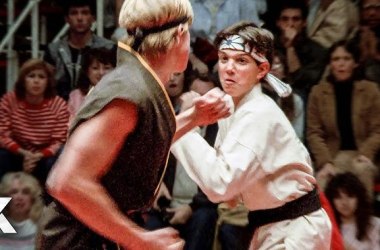
Then, in one of the all-time worst decisions in karate history, real or fictional, Johnny walks right into Daniel’s crane kick.
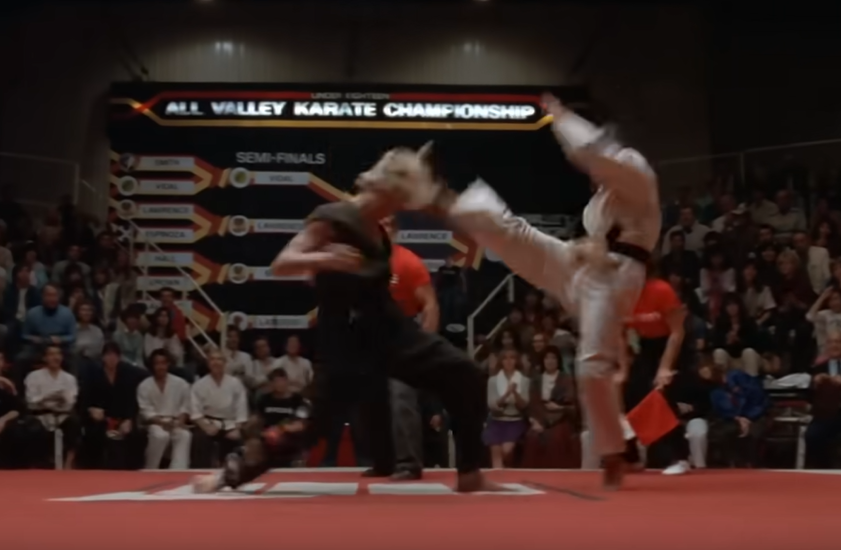
The rest, as they say, is history. Daniel goes on to appear in two more films. In The Karate Kid Part II, which takes place six months after the events of the first film, Daniel accompanies Miyagi back to his home island of Okinawa to see his dying father one last time. While there, Daniel has a fight-to-the-near-death with a local tough, Chozen, played by Yuji Okumoto, who reprises the role in Cobra Kai; regretful of his past actions, he becomes Daniel’s close friend and fellow sensei in the revived Miyagi-do dojo. Finally in Part III, Daniel breaks from Miyagi, who refuses to train him to defend his All-Valley title, and instead trains with Terry Silver (Thomas Ian Griffith), a war comrade of Kreese, in the aggressive Cobra Kai style. Ultimately, though, Silver’s nefarious scheme to re-establish Cobra Kai causes Daniel to change his mind and return to Miyagi, whose instruction helps the youngster repeat as All-Valley champ.
The Next Karate Kid, the final entry in the original series, is regarded as the worst of the four. Miyagi is the only character from any of the first three films to appear; he travels east to Boston and begins training a young woman, played by Hilary Swank in her first starring role. The film’s box office was less than 10% of the first entry’s, and reviews were scathing, other than praise for the performances by Morita as Miyagi and Swank as Julie. Twenty years old at the time, Swank would go on to win a pair of Best Actress Oscars, the second of which was for her portrayal of Maggie in Clint Eastwood’s boxing film, Million-Dollar Baby. (There was much speculation among Cobra Kai fans as to whether Swank’s Julie would make at least a cameo in the series, as so many from the original films did, but we never saw her.)
One kick sets up a great life, and ruins another.
When Cobra Kai opens, it’s 34 years after the events of the first film. The Cobra Kai dojo disbanded after Johnny’s defeat and the revelation that Kreese’s unethical coaching had contributed to Daniel’s injury. Daniel has parlayed his teenage karate celebrity into a successful business career as the owner of a string of luxury car dealerships. He’s married and the father of teenagers Samantha and Anthony. Karate is a thing of Daniel’s past now, several years after the death of Miyagi (Morita died in 2005). But what happened to the guys in black who had fought against Daniel?
Well, not much good. The gang of high-kicking, trash-talking teenage boys who trained under Kreese has not aged particularly well. One or two have died. One became a minister, renouncing his youthful ways. And Johnny…well, that’s a sad story.
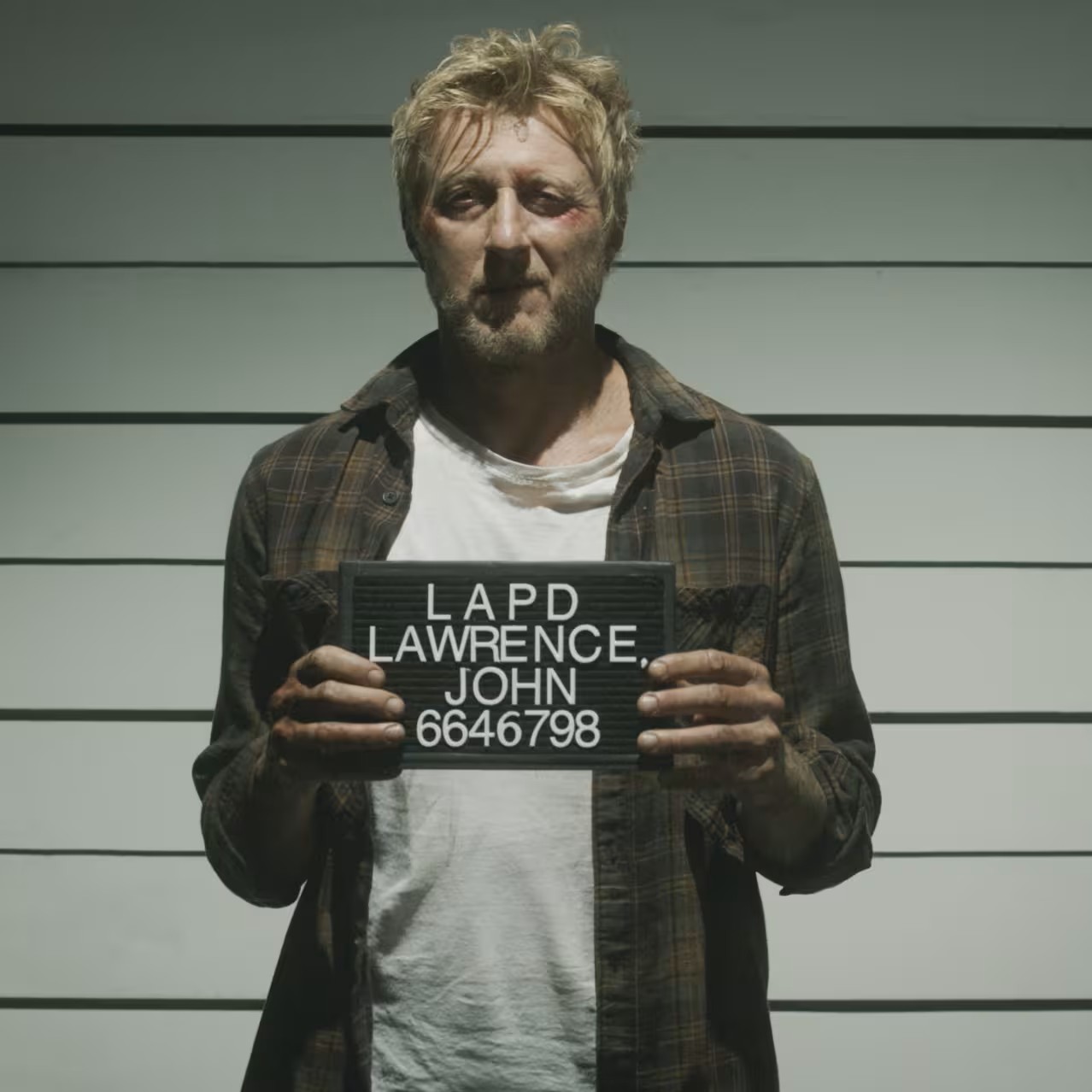
A lot happens over the course of six seasons, but the overriding theme is Johnny’s journey from a bum to a reliable employee, husband and father, not to mention world-champion karate fighter. Late in 2019, after the first two seasons had aired on YouTube, I met Zabka at a convention in Minneapolis. He was a little smaller than I imagined (six-feet even) but obviously in very good shape at age 54. I had a nice chat with him about the character arc of Johnny, and of course got a couple pictures.

In the 65th and final episode of the series, Johnny gets his chance at last. He’s just about come full circle. He and Daniel are now good friends, having long ago buried the hatchet from their teenage showdown; Johnny even works for Daniel’s dealership now. He’s reconciled with his son, Robby, who has become one of the dojo’s top students, and he’s married to Carmen and they have a newborn daughter. The prestigious Sekai Taikai international tournament has come down to one final bout for the team championship: Johnny vs Wolf, the sensei of the Hong Kong-based dojo, backed by Silver. Johnny and Daniel’s top male and female teenage fighters won their respective title bouts over Wolf’s students to gain individual world championships and tie the two dojos for the team title. To break the tie, the dojos’ senseis will square off. Johnny is nervous, unsure that he still has the ability to challenge the younger, more aggressive Wolf (played by Lewis Tan, 38, who’s trained in martial arts since childhood). But thanks to the support of his students, who all turn out wearing Cobra Kai uniforms, and a stern talking-to from Daniel, Johnny rallies and emerges triumphant.


The final bouts–the two kids’ fights in the penultimate episode and Johnny vs Wolf in the finale–were among the most exciting and well-done of the entire series, which is saying something, because the martial arts choreography has been first-rate throughout. Yes, we veteran martial arts competitors had to quibble a bit: unlike real-life tournaments, the Cobra Kai showdowns, even those in the original film series, did not have the competitors wearing gloves, helmets, vests, or even mouth guards. But, as I told my son Jim, who has a 2nd-degree black belt in taekwondo, you have to get past that and enjoy the story. The martial arts combat itself, both on and off the mat, was pretty realistic, with the actors doing most of their own fight scenes.
It’s said there will be a spinoff series or two from Cobra Kai, and there’s an upcoming feature film, Karate Kid: Legends, in which Macchio returns as Daniel, alongside Jackie Chan, mentoring a young student, but I think we’ve seen the last of Johnny Lawrence. As the final episode closed, Johnny had bought a new home for himself and his young family, and new students were lining up outside the doors of the Cobra Kai dojo to learn the art at the home of the best karate fighters on the planet. Onward and upward for Johnny, at last.
Just about every guy can identify with Johnny, at least to a certain extent. I didn’t take up martial arts training till I was in my 40s, so I never had a youthful defeat on the mat like he did. But, I did have a crushing loss in my final high school basketball game, scoring only one point in a tournament defeat at the hands of Belmont. The 50th anniversary of that game is coming up in a week or so. I never let that loss define me, though, as Johnny did for his. I worked my way through college, embarked on a successful radio career and eventually met the love of my life in my mid-30s; Johnny was in his late 50s when he and Carmen got together. So, yeah, I never let my biggest teenage athletic failure rule my life for the next four decades.
But, I could still root for Johnny, and I did, along with millions of other men and more than a few women, I’m sure. During his climactic bout for the world title, I was on my feet, yelling encouragement. Sue was standing, as well. I got emotional as the trophy was hoisted by the two old rivals. I’d been rooting for Johnny every step of the way for 65 episodes over the span of 7 years. At times, it looked like he might not be able to make it, but he persevered. He had lived a sad life without friendship, success, love, or honor, but in the end, he found all of them.
Way to go, Johnny.

 A Strenuous Writer's Life